Stellar Throne Devlog 11: New Architecture, New Partner, New Direction
Stellar Throne is a 4X sci-fi strategy game I'm building as a solo developer. It's been four months since Devlog #10. That post ended with "next phase: combat resolution." What actually happened was 475 commits, a complete architecture change, a creative partnership, and a fundamental rethink of what kind of 4X game Stellar Throne wants to be.
This is the biggest shift in the project's history, and I'm more excited about it than I've been at any point in development.
The New Architecture: C Simulation + Unity Frontend
The original Stellar Throne stack went through several iterations — GDScript, then a Zig simulation backend paired with a Godot frontend, then a C rewrite with an SDL frontend. Each migration taught me something, but the SDL frontend was always a means to an end. It got the game playable. It was never going to make it beautiful.
So we're deprecating SDL and moving to Unity for the frontend.
The C simulation library stays. It's fast, it's stable, and it's ideal for AI-assisted development — I can iterate on game logic with Claude Code at a pace that wouldn't be possible in a more complex engine. The C API was hardened for Unity P/Invoke integration over the last few months: removing SDL dependencies from the simulation library, fixing struct packing for cross-platform compatibility, and stress-testing the boundary between the two layers.
The architecture now looks like this:
- C simulation library — all game logic, turn resolution, AI, combat, economy. Compiles as a shared library.
- Unity frontend — rendering, UI, animations, audio, visual effects. Calls into the C library via P/Invoke.
- Clean API boundary — the simulation knows nothing about how it's displayed. Unity asks for game state, renders it, sends player actions back.
This separation isn't just an engineering convenience. It's what makes the next piece possible.
Partnering with Pixel Cows
I'm collaborating with Pixel Cows on Stellar Throne. They bring game design and art expertise that I frankly don't have — and that the game needs if it's going to stand out in a crowded 4X market.
This isn't an acquisition or a hand-off. It's a collaboration. Their design and art strengths complement my engineering strengths. I've spent the better part of a year building a simulation engine that can run a complex 4X galaxy. Now it needs to look and feel like one. Pixel Cows has deep experience in Unity, which is why Unity was the natural choice for the new frontend.
The Unity work is just now starting. More to show soon.
Shorter Play Sessions
Here's the design pivot that's been shaping everything else: we're pushing Stellar Throne toward shorter play sessions.
Traditional 4X games are massive time commitments. A single Civilization game can run twenty, thirty, even forty hours. That's fine for a certain audience, but it locks out a huge number of players who want the strategic depth of a 4X without dedicating an entire weekend.
Our target is 2–4 hours for a full game — an order of magnitude shorter than Civilization, but long enough to feel the arc of building an empire, clashing with rivals, and claiming victory.
This has driven real mechanical changes:
- Simplified combat. We removed the defense stat entirely and moved to a clean HP-attrition model. Fights resolve faster and the outcomes are more intuitive — you can eyeball whether you'll win before committing.
- Immediate combat on fleet movement. No more moving fleets into position and waiting for a combat phase. Move into an enemy, fight happens now. This cuts dead turns and keeps the pace up.
- Rebalanced barbarians. Neutral enemies (Sentinels and barbarians) got significant nerfs. They're obstacles and flavor, not brick walls that stall your expansion for twenty turns.
- Rush-buy economy. You can queue buildings and ships for free, but instant-purchase them with credits. This gives players who know what they want a way to skip the waiting.
None of this sacrifices strategic depth. It removes friction. There's a difference.
Coloring the Map
Of the several victory conditions in Stellar Throne, territorial control is shaping up to be the most fun.
The star annexation system lets empires claim stars within their sphere of influence. As you annex more stars, your empire's color fills across the galaxy map — borders expanding, territory solidifying, your faction's presence becoming visible at a glance.
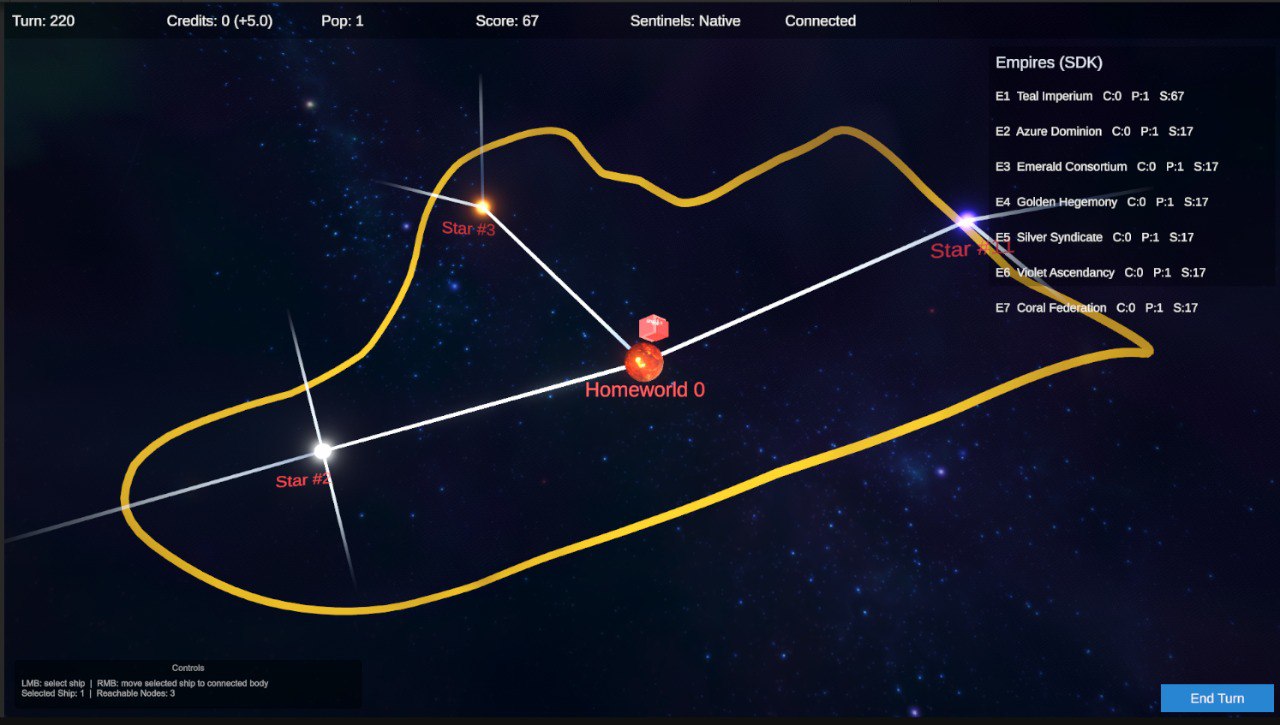
It's the same satisfaction loop that makes Risk and Civilization's cultural borders compelling. You look at the map and see your color spreading. You see gaps you want to fill. You see an opponent's territory pushing up against yours and start planning how to push back.
Territory control isn't the only way to win, but it's the one that makes you feel like you're winning while you're doing it.
Bidding for Stars: The Annexation Economy
Annexation isn't free. Claiming a star costs credits — and here's where it gets interesting: other empires can outbid you.
If you annex a star at the edge of your territory, a rival with a stronger economy can pour more credits into it and flip it to their control. Your economy isn't just funding ships and buildings. It's funding your grip on the map itself.
This creates a strategic tension that runs through every decision: do you spread thin and grab as many stars as possible, knowing you might not be able to hold them all? Or do you consolidate a smaller, defensible sphere of influence and invest heavily in the planets you have?
The bidding system means your economy is always load-bearing. You can't just build up a military and ignore your treasury, because a rich neighbor will erode your borders without ever firing a shot.
Relics of the Ancients
Scattered across 5% of the galaxy's stars are relics — artifacts left behind by a long-dead civilization. There are 33 of them, spanning 11 stat categories across three tiers of power.
Tier 1 relics grant +3 to a stat. Things like the Fertile Seeds (food production), Trade Cipher (economy), or Combat Chip (military tech). Useful early, worth grabbing if they're nearby.
Tier 2 relics grant +6. The Research Codex, Fleet Banner, Territory Seal. Now you're building strategy around which relics you control.
Tier 3 relics grant +10. The Genesis Engine. The Omniscience Core. The Dominion Crown. The Warlord Helm. These are game-changers. An empire holding two or three Tier 3 relics has a tangible advantage that other players can see — and will want to take.
But relics aren't free for the taking. They're guarded by Sentinels — remnants of the ancient civilization's defense network. You have to conquer the star first, fighting through the Sentinel fleet. Then you invest science to research and unlock the relic. Tier 1 costs 8 science, Tier 2 costs 16, Tier 3 costs 32.
This conquer-then-research flow creates natural decision points. Do you rush a Tier 3 relic star early, before you have the military to easily take it? Do you invest your science budget in relics or in R&D for broader bonuses? And once you hold a relic, you have to keep holding the star — which means defending it militarily.
Relics give the galaxy map strategic texture. Not every star is equal. Some are worth fighting wars over.
475 Commits of Everything Else
Beyond the headline changes, there's been a mountain of work under the hood:
- Embedded QuickJS for map generation. The original galaxy map generator was a JavaScript prototype. Rather than rewrite it in C and risk subtle divergences, we embedded QuickJS directly and run the original JS code. Faithful output, zero porting bugs.
- MCP proxy to decouple the game from Claude Code sessions. The simulation can now communicate with AI tools without being tied to a specific terminal session.
- Dozens of bug fixes — fleet disappearance in late game, combat visualizer survival bugs, fog of war visibility glitches, sprite batch overflow, and more.
This is what 475 commits in four months looks like. I wrote recently about Jevons' paradox and AI-assisted development — the idea that making development cheaper doesn't mean building less, it means building more. Stellar Throne is a case study. The C simulation, the architecture migration, the relic system, the annexation economy — this volume of work wouldn't be possible without AI-powered game development tools, and the new partnership with Pixel Cows means that increased output is now being paired with professional art and design.
What's Next
The Unity frontend is the immediate priority. Pixel Cows is ramping up on the visual side while we continue refining the simulation — if you're building games with similar tools, check out the indie game dev tools directory we maintain. Expect the next devlog to have actual screenshots of the new look.
The game is in a fundamentally different place than it was four months ago. The simulation is mature. The mechanics are fun. The architecture is clean. Now it needs to look as good as it plays.
We're building.